
The False Dilemma of the German CTO
When a German company in a regulated sector looks for a development partner, the market typically presents two options: 100% senior teams with guaranteed quality but high costs and limited scaling capacity, or junior-heavy teams that are cheaper but carry unacceptable quality risk in critical environments.
The reality is that neither extreme is optimal. A 100% senior team is expensive to maintain and difficult to scale quickly. A team without solid senior leadership generates technical debt, production bugs, and regulatory risk.
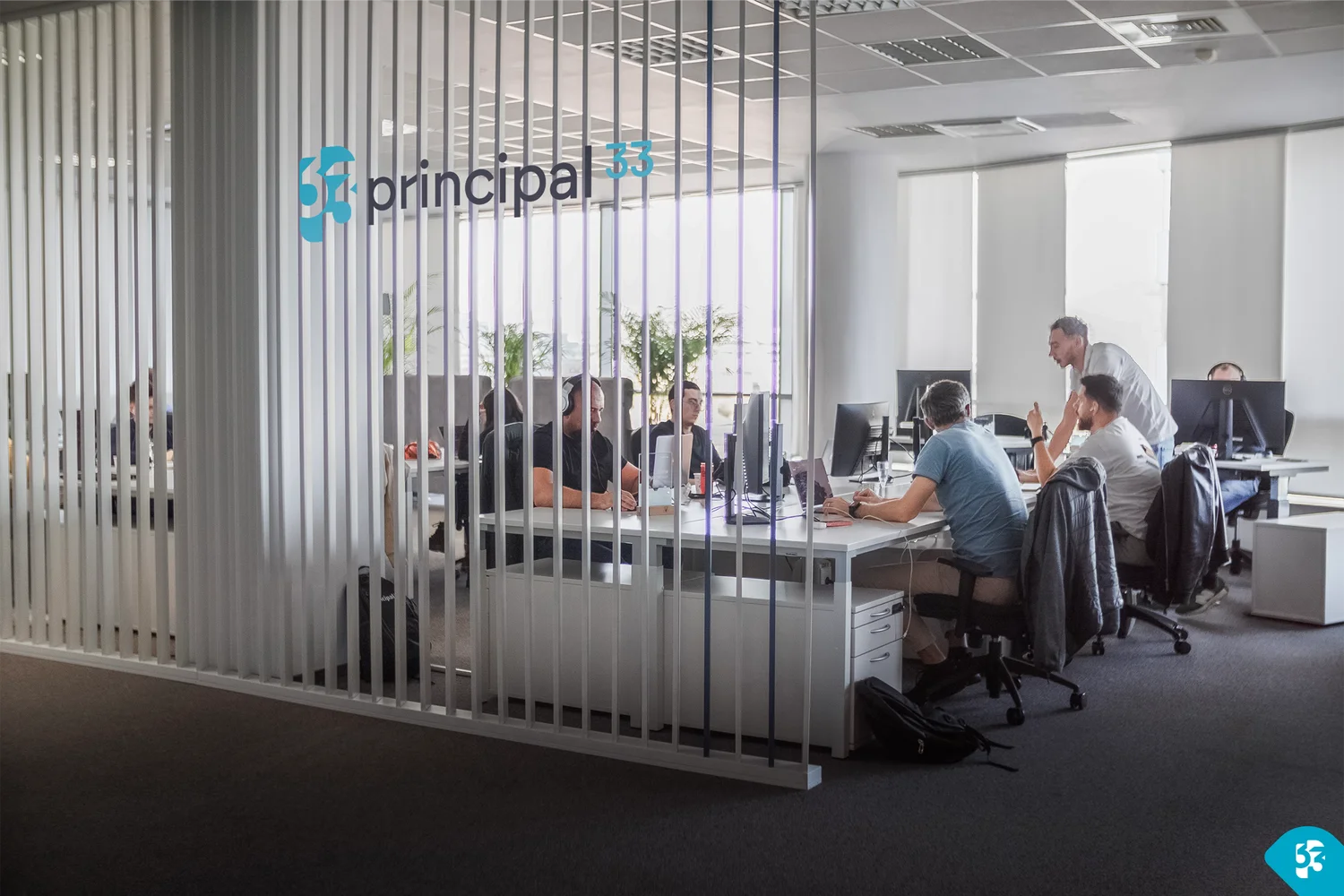
Principal33 works with a third model: hybrid seniority squads, where senior profiles lead the architecture, guarantee quality, and manage technical risk, while mid and junior profiles contribute execution capacity, operational efficiency, and scalability. The result: senior quality, team efficiency.
What the Hybrid Seniority Squad Model Is
The model is not new in high-performance software engineering. What makes it effective is not the exact ratio of seniors to juniors, but the structure, methodology, and technical leadership that guarantee every line of code meets the project’s quality standards.
Typical Principal33 Squad Composition
Senior Profile (technical lead):
- System architecture and high-impact technical decisions
- Structural and business code review
- Technical and regulatory risk management
- Active team mentoring
- Direct client interaction on technical matters
Mid-Level Profile (expert execution):
- Development of complex features autonomously
- Integration testing and validation
- Technical documentation
- Active collaboration in solution design
Junior Profile (efficient execution):
- Development of standard features under senior guidance
- Unit and regression testing
- Configuration and parameterization tasks
- Accelerated growth within the squad
PM/Scrum Master:
- Sprint, impediment, and stakeholder management
- Velocity, risk, and progress reporting
- Coordination between teams and client
Why This Model Works
The key isn’t how many seniors there are, but how the workflow is structured:
- Architecture defined by seniors before the team starts developing → fewer rewrites, less technical debt
- Mandatory code review by senior profiles on all critical pull requests → quality guaranteed without slowing the team
- Technical pairing between seniors and juniors on complex features → real knowledge transfer without impacting delivery
- Demanding Definition of Done → no feature goes to production without meeting quality, security, and documentation standards
- Weekly quality retrospectives → continuous improvement of process and team
The Optimal Point Between Quality and Efficiency
Model Comparison
| Criterion | Seniors only | Principal33 Hybrid Model | Junior-heavy |
| Technical quality | Maximum | High (guaranteed by seniors) | Variable |
| Cost per FTE | €80K-€120K/year | €40K-€70K/year (average) | €25K-€45K/year |
| Scalability | Low | High | High |
| Delivery speed | High | High | Medium-low |
| Technical debt | Minimal | Controlled | High |
| Regulatory risk | Low | Low (senior leadership) | High |
| Knowledge transfer | Low | High (structured mentoring) | High (but of what) |
| Team flexibility | Low | High | High |
Principal33’s hybrid model consistently occupies the optimal point: technical quality guaranteed by senior leadership, with the operational efficiency and scalability that only a complete team can offer.
When the Hybrid Model Outperforms the 100% Senior Model
In long-term projects (>6 months): A 100% senior team is difficult to keep stable. Senior profile turnover is high in the German market. A hybrid model with solid seniors and a stable mid/junior team is more sustainable, predictable, and scalable.
In projects with heterogeneous components: Not all project features require the same level of expertise. A customer self-service portal, automated testing, or configuration tasks don’t need 5 years of experience to execute correctly. Optimizing talent allocation is business intelligence, not quality reduction.
In projects that need to scale quickly: If the project grows and you need to go from 3 to 8 people in 6 weeks, a hybrid model allows quickly incorporating junior and mid profiles, always under the umbrella of the already-established senior leadership. Scaling a 100% senior team in that time is practically impossible.
Real Case: Custom Platform for German Regulated Sector
Context
German aerospace sector client needed a custom platform for complex contract management and commercial lifecycle. Integrations with legacy systems (Oracle DB), external APIs, and mobile user experience requirements. Immovable deadline tied to commercial launch.
Principal33 Squad (Hybrid Model)
- 1 Senior Salesforce Architect (>7 years) – Architecture, technical decisions, code review, client interaction
- 1 Senior AWS Engineer (>6 years) – Integration design with Oracle and external APIs, security
- 2 Mid-Level Salesforce Developers (3-5 years) – Core feature development, integration testing
- 1 Junior Frontend Developer (1-2 years) – UI component development, unit testing, under senior guidance
- 1 PM/Scrum Master – Sprint management, reporting, stakeholders
Applied Methodology
- Weeks 1-3: Architecture defined by seniors, no business code lines written
- Weeks 4-14: Development in 2-week sprints, mandatory code review on critical PRs, weekly technical pairing
- Weeks 12-14: Integral testing, security hardening, documentation
Results
- Delivered on time – 14 weeks without extensions
- Zero critical production bugs – 6 months post go-live without P1 incidents
- Maintainable architecture – Automated tests >80% coverage, complete documentation
- Budget 100% respected – No surprises in the final invoice
- 35% lower cost than an equivalent 100% senior team – Without compromising quality
Key factor: The investment in architecture during the first 3 weeks (led by seniors) allowed mid and junior profiles to execute the rest of the project autonomously and with quality.
Why the Nearshore Model Makes This Balance Possible
In Germany, even a hybrid model with 2 seniors and 3 mid/junior costs between €300K-€450K annually hiring internally. Principal33’s nearshore model optimizes that equation without sacrificing quality:
- Technical teams in Romania (Cluj-Napoca, Brașov, Târgu Mureș) with high-level senior profiles and European-quality mid/junior, at costs 40-50% lower than Germany
- Same CET time zone – Real-time collaboration without friction
- European culture – Direct communication, understanding of German business context, aligned work ethic
- Düsseldorf office for local presence, workshops, kick-offs, and governance
- On-call in native German for direct communication during incidents or escalations
The result: the optimal point between quality, efficiency, and cost, with the security of a local office and a 100% client retention track record.
Measurable Benefits of the Hybrid Model
Technical Quality:
- 65% reduction in production bugs vs teams without structured senior leadership
- Controlled technical debt – Clean architecture from week 1, continuous refactoring
- Regulatory audits passed – Zero critical findings in pharma, aerospace, and energy projects
Delivery Efficiency:
- Competitive time-to-market with the quality of a senior team
- Real scalability – Incorporate new mid/junior profiles in 4-6 weeks under established senior leadership
- Predictable sprints – Stable velocity thanks to core senior team stability
Cost Optimization:
- 35-45% savings vs equivalent 100% senior model in Germany
- No hidden costs of onboarding, turnover, or talent management
- Positive ROI in 6-9 months for custom development projects
Why Choose Principal33 for Software Engineering
Proven Squad Model We’ve spent over 4 years perfecting the hybrid squad model with clients in energy, pharma, aerospace, and automotive. The structure, methodology, and quality standards are documented and repeatable.
Rigorous Selection at All Levels Not only seniors go through a demanding selection process. Every mid and junior in the squad is technically evaluated and for their ability to work under Principal33’s quality methodology. Quality doesn’t depend only on seniority: it depends on the process.
Verified Technologies Salesforce (Sales Cloud, Service Cloud, Experience Cloud), AWS, Azure, cloud-native architectures (microservices, REST/GraphQL APIs, Docker/Kubernetes). The same seniors who lead projects are those who define technological standards.
Transparent Delivery Model
- 2-week sprints with demo and retrospective
- Direct access to senior technical lead, without intermediaries
- Weekly velocity, risk, and quality reporting
- Architecture documented and transferred to client upon completion
Certifications and Guarantees
- ISO 9001:2015 – Quality processes audited annually
- ISO 27001:2013 – Certified information security
- 100% client retention in 4 years
- Senior leadership guarantee – The assigned architect/tech lead remains stable throughout the project
Conclusion
For German companies in regulated sectors, the hybrid squad model is not a concession, it’s the optimal solution. It combines the technical quality guarantee that only senior leadership provides with the efficiency, scalability, and cost optimization that real projects require.
Principal33 has perfected this model over more than 4 years working with German leaders in energy, pharma, aerospace, and automotive: seniors who guarantee technical excellence, complete teams that make delivery possible, all from a nearshore office with local presence in Düsseldorf.
Want to evaluate how a hybrid squad can accelerate your deliveries without compromising quality? Our Düsseldorf team can perform a no-obligation assessment, designing the optimal squad composition for your specific project.
About Principal33
Principal33 is a nearshore IT partner with over 250 professionals specialized in Software Engineering, Application Maintenance & Support, Cloud Migration, and Data & AI for regulated sectors. With offices in Düsseldorf (Germany), Cluj-Napoca, Brașov, Târgu Mureș (Romania), and Valencia (Spain), we offer hybrid squads with guaranteed senior leadership, ISO 9001 and ISO 27001 certifications, and a 100% client retention track record in utilities, pharma, aerospace, and automotive.